 Add to Chrome
 Add to Firefox
 Add to Edge
OpenMobile: Building Open Mobile Agents with Task and Trajectory Synthesis
Apr 16, 2026
Mobile agents powered by vision-language models have demonstrated impressive capabilities in automating mobile tasks, with recent leading models achieving a marked performance leap, e.g., nearly 70% success on AndroidWorld. However, these systems keep their training data closed and remain opaque about their task and trajectory synthesis recipes. We present OpenMobile, an open-source framework that synthesizes high-quality task instructions and agent trajectories, with two key components: (1) The first is a scalable task synthesis pipeline that constructs a global environment memory from exploration, then leverages it to generate diverse and grounded instructions. and (2) a policy-switching strategy for trajectory rollout. By alternating between learner and expert models, it captures essential error-recovery data often missing in standard imitation learning. Agents trained on our data achieve competitive results across three dynamic mobile agent benchmarks: notably, our fine-tuned Qwen2.5-VL and Qwen3-VL reach 51.7% and 64.7% on AndroidWorld, far surpassing existing open-data approaches. Furthermore, we conduct transparent analyses on the overlap between our synthetic instructions and benchmark test sets, and verify that performance gains stem from broad functionality coverage rather than benchmark overfitting. We release data and code at https://njucckevin.github.io/openmobile/ to bridge the data gap and facilitate broader mobile agent research.

OdysseyArena: Benchmarking Large Language Models For Long-Horizon, Active and Inductive Interactions
Feb 05, 2026The rapid advancement of Large Language Models (LLMs) has catalyzed the development of autonomous agents capable of navigating complex environments. However, existing evaluations primarily adopt a deductive paradigm, where agents execute tasks based on explicitly provided rules and static goals, often within limited planning horizons. Crucially, this neglects the inductive necessity for agents to discover latent transition laws from experience autonomously, which is the cornerstone for enabling agentic foresight and sustaining strategic coherence. To bridge this gap, we introduce OdysseyArena, which re-centers agent evaluation on long-horizon, active, and inductive interactions. We formalize and instantiate four primitives, translating abstract transition dynamics into concrete interactive environments. Building upon this, we establish OdysseyArena-Lite for standardized benchmarking, providing a set of 120 tasks to measure an agent's inductive efficiency and long-horizon discovery. Pushing further, we introduce OdysseyArena-Challenge to stress-test agent stability across extreme interaction horizons (e.g., > 200 steps). Extensive experiments on 15+ leading LLMs reveal that even frontier models exhibit a deficiency in inductive scenarios, identifying a critical bottleneck in the pursuit of autonomous discovery in complex environments. Our code and data are available at https://github.com/xufangzhi/Odyssey-Arena
TIDE: Trajectory-based Diagnostic Evaluation of Test-Time Improvement in LLM Agents
Feb 03, 2026Recent advances in autonomous LLM agents demonstrate their ability to improve performance through iterative interaction with the environment. We define this paradigm as Test-Time Improvement (TTI). However, the mechanisms under how and why TTI succeed or fail remain poorly understood, and existing evaluation metrics fail to capture their task optimization efficiency, behavior adaptation after erroneous actions, and the specific utility of working memory for task completion. To address these gaps, we propose Test-time Improvement Diagnostic Evaluation (TIDE), an agent-agnostic and environment-agnostic framework that decomposes TTI into three comprehensive and interconnected dimensions. The framework measures (1) the overall temporal dynamics of task completion and (2) identifies whether performance is primarily constrained by recursive looping behaviors or (3) by burdensome accumulated memory. Through extensive experiments across diverse agents and environments, TIDE highlights that improving agent performance requires more than scaling internal reasoning, calling for explicitly optimizing the interaction dynamics between the agent and the environment.
SSL: Sweet Spot Learning for Differentiated Guidance in Agentic Optimization
Jan 30, 2026Reinforcement learning with verifiable rewards has emerged as a powerful paradigm for training intelligent agents. However, existing methods typically employ binary rewards that fail to capture quality differences among trajectories achieving identical outcomes, thereby overlooking potential diversity within the solution space. Inspired by the ``sweet spot'' concept in tennis-the racket's core region that produces optimal hitting effects, we introduce \textbf{S}weet \textbf{S}pot \textbf{L}earning (\textbf{SSL}), a novel framework that provides differentiated guidance for agent optimization. SSL follows a simple yet effective principle: progressively amplified, tiered rewards guide policies toward the sweet-spot region of the solution space. This principle naturally adapts across diverse tasks: visual perception tasks leverage distance-tiered modeling to reward proximity, while complex reasoning tasks reward incremental progress toward promising solutions. We theoretically demonstrate that SSL preserves optimal solution ordering and enhances the gradient signal-to-noise ratio, thereby fostering more directed optimization. Extensive experiments across GUI perception, short/long-term planning, and complex reasoning tasks show consistent improvements over strong baselines on 12 benchmarks, achieving up to 2.5X sample efficiency gains and effective cross-task transferability. Our work establishes SSL as a general principle for training capable and robust agents.
$A^3$-Bench: Benchmarking Memory-Driven Scientific Reasoning via Anchor and Attractor Activation
Jan 14, 2026Scientific reasoning relies not only on logical inference but also on activating prior knowledge and experiential structures. Memory can efficiently reuse knowledge and enhance reasoning consistency and stability. However, existing benchmarks mainly evaluate final answers or step-by-step coherence, overlooking the \textit{memory-driven} mechanisms that underlie human reasoning, which involves activating anchors and attractors, then integrating them into multi-step inference. To address this gap, we propose $A^3$-Bench~ https://a3-bench.github.io, a benchmark designed to evaluate scientific reasoning through dual-scale memory-driven activation, grounded in Anchor and Attractor Activation. First, we annotate 2,198 science reasoning problems across domains using the SAPM process(subject, anchor & attractor, problem, and memory developing). Second, we introduce a dual-scale memory evaluation framework utilizing anchors and attractors, along with the AAUI(Anchor--Attractor Utilization Index) metric to measure memory activation rates. Finally, through experiments with various base models and paradigms, we validate $A^3$-Bench and analyze how memory activation impacts reasoning performance, providing insights into memory-driven scientific reasoning.
OS-Symphony: A Holistic Framework for Robust and Generalist Computer-Using Agent
Jan 12, 2026While Vision-Language Models (VLMs) have significantly advanced Computer-Using Agents (CUAs), current frameworks struggle with robustness in long-horizon workflows and generalization in novel domains. These limitations stem from a lack of granular control over historical visual context curation and the absence of visual-aware tutorial retrieval. To bridge these gaps, we introduce OS-Symphony, a holistic framework that comprises an Orchestrator coordinating two key innovations for robust automation: (1) a Reflection-Memory Agent that utilizes milestone-driven long-term memory to enable trajectory-level self-correction, effectively mitigating visual context loss in long-horizon tasks; (2) Versatile Tool Agents featuring a Multimodal Searcher that adopts a SeeAct paradigm to navigate a browser-based sandbox to synthesize live, visually aligned tutorials, thereby resolving fidelity issues in unseen scenarios. Experimental results demonstrate that OS-Symphony delivers substantial performance gains across varying model scales, establishing new state-of-the-art results on three online benchmarks, notably achieving 65.84% on OSWorld.
A Foundation Model for Chest X-ray Interpretation with Grounded Reasoning via Online Reinforcement Learning
Sep 04, 2025Medical foundation models (FMs) have shown tremendous promise amid the rapid advancements in artificial intelligence (AI) technologies. However, current medical FMs typically generate answers in a black-box manner, lacking transparent reasoning processes and locally grounded interpretability, which hinders their practical clinical deployments. To this end, we introduce DeepMedix-R1, a holistic medical FM for chest X-ray (CXR) interpretation. It leverages a sequential training pipeline: initially fine-tuned on curated CXR instruction data to equip with fundamental CXR interpretation capabilities, then exposed to high-quality synthetic reasoning samples to enable cold-start reasoning, and finally refined via online reinforcement learning to enhance both grounded reasoning quality and generation performance. Thus, the model produces both an answer and reasoning steps tied to the image's local regions for each query. Quantitative evaluation demonstrates substantial improvements in report generation (e.g., 14.54% and 31.32% over LLaVA-Rad and MedGemma) and visual question answering (e.g., 57.75% and 23.06% over MedGemma and CheXagent) tasks. To facilitate robust assessment, we propose Report Arena, a benchmarking framework using advanced language models to evaluate answer quality, further highlighting the superiority of DeepMedix-R1. Expert review of generated reasoning steps reveals greater interpretability and clinical plausibility compared to the established Qwen2.5-VL-7B model (0.7416 vs. 0.2584 overall preference). Collectively, our work advances medical FM development toward holistic, transparent, and clinically actionable modeling for CXR interpretation.
Graph-R1: Towards Agentic GraphRAG Framework via End-to-end Reinforcement Learning
Jul 29, 2025Retrieval-Augmented Generation (RAG) mitigates hallucination in LLMs by incorporating external knowledge, but relies on chunk-based retrieval that lacks structural semantics. GraphRAG methods improve RAG by modeling knowledge as entity-relation graphs, but still face challenges in high construction cost, fixed one-time retrieval, and reliance on long-context reasoning and prompt design. To address these challenges, we propose Graph-R1, an agentic GraphRAG framework via end-to-end reinforcement learning (RL). It introduces lightweight knowledge hypergraph construction, models retrieval as a multi-turn agent-environment interaction, and optimizes the agent process via an end-to-end reward mechanism. Experiments on standard RAG datasets show that Graph-R1 outperforms traditional GraphRAG and RL-enhanced RAG methods in reasoning accuracy, retrieval efficiency, and generation quality.
ScienceBoard: Evaluating Multimodal Autonomous Agents in Realistic Scientific Workflows
May 26, 2025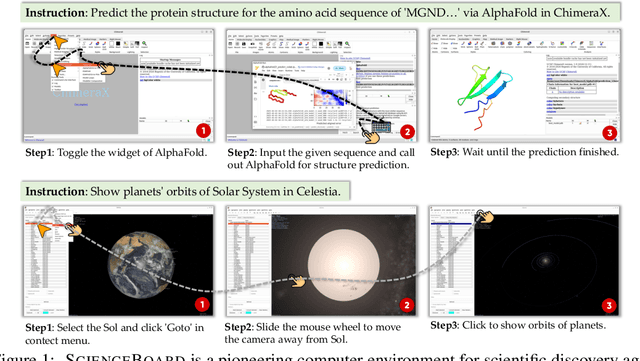
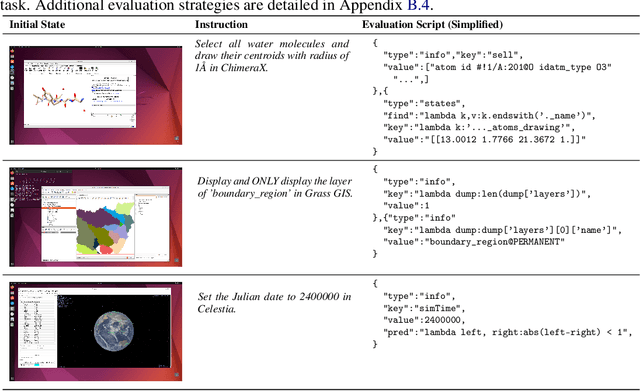
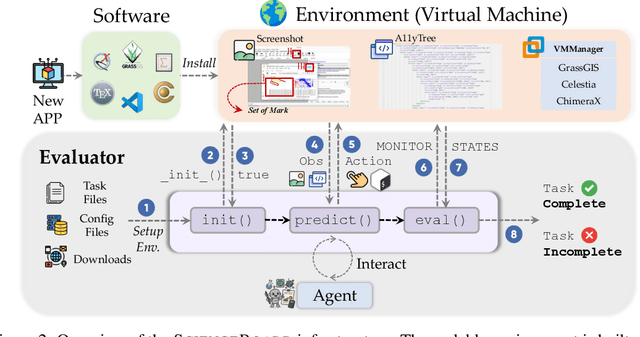
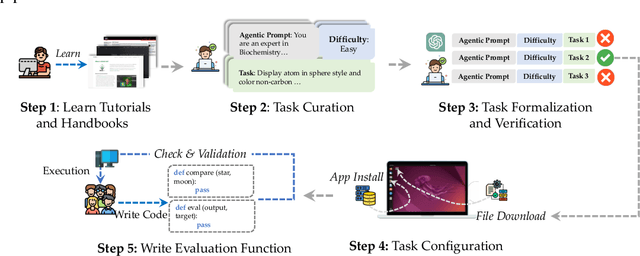
Large Language Models (LLMs) have extended their impact beyond Natural Language Processing, substantially fostering the development of interdisciplinary research. Recently, various LLM-based agents have been developed to assist scientific discovery progress across multiple aspects and domains. Among these, computer-using agents, capable of interacting with operating systems as humans do, are paving the way to automated scientific problem-solving and addressing routines in researchers' workflows. Recognizing the transformative potential of these agents, we introduce ScienceBoard, which encompasses two complementary contributions: (i) a realistic, multi-domain environment featuring dynamic and visually rich scientific workflows with integrated professional software, where agents can autonomously interact via different interfaces to accelerate complex research tasks and experiments; and (ii) a challenging benchmark of 169 high-quality, rigorously validated real-world tasks curated by humans, spanning scientific-discovery workflows in domains such as biochemistry, astronomy, and geoinformatics. Extensive evaluations of agents with state-of-the-art backbones (e.g., GPT-4o, Claude 3.7, UI-TARS) show that, despite some promising results, they still fall short of reliably assisting scientists in complex workflows, achieving only a 15% overall success rate. In-depth analysis further provides valuable insights for addressing current agent limitations and more effective design principles, paving the way to build more capable agents for scientific discovery. Our code, environment, and benchmark are at https://qiushisun.github.io/ScienceBoard-Home/.
ChartSketcher: Reasoning with Multimodal Feedback and Reflection for Chart Understanding
May 25, 2025Charts are high-density visualization carriers for complex data, serving as a crucial medium for information extraction and analysis. Automated chart understanding poses significant challenges to existing multimodal large language models (MLLMs) due to the need for precise and complex visual reasoning. Current step-by-step reasoning models primarily focus on text-based logical reasoning for chart understanding. However, they struggle to refine or correct their reasoning when errors stem from flawed visual understanding, as they lack the ability to leverage multimodal interaction for deeper comprehension. Inspired by human cognitive behavior, we propose ChartSketcher, a multimodal feedback-driven step-by-step reasoning method designed to address these limitations. ChartSketcher is a chart understanding model that employs Sketch-CoT, enabling MLLMs to annotate intermediate reasoning steps directly onto charts using a programmatic sketching library, iteratively feeding these visual annotations back into the reasoning process. This mechanism enables the model to visually ground its reasoning and refine its understanding over multiple steps. We employ a two-stage training strategy: a cold start phase to learn sketch-based reasoning patterns, followed by off-policy reinforcement learning to enhance reflection and generalization. Experiments demonstrate that ChartSketcher achieves promising performance on chart understanding benchmarks and general vision tasks, providing an interactive and interpretable approach to chart comprehension.